
Short answer. PPWR treats every packaging that is placed on the market as its own compliance object, and a Declaration of Conformity (DoC) is drawn up per that object. The point that settles most cases is knowing when an element is part of one packaging, in which case it is a component inside one DoC, and when it is used to fixate several packagings together, in which case it is its own packaging with its own DoC. Tape that closes one carton is part of that carton. Tape bundling three cartons, straps around a pallet, and stretch wrap around a load are fixation, so each is its own packaging with its own DoC.
The one distinction that settles itAsk a single question about any element on the pack:
Is it part of a packaging, or is it used to fixate several packagings together?
If it serves one packaging, it is a component, and it is assessed inside that packaging's single DoC. If it fixates a group, it is its own packaging, with its own DoC. That is the whole rule. Everything below is applying it.
Worked examplesTape or a label that closes and marks one outer carton is a component of that carton. Carton, tape and label together form one unit, and that unit gets one DoC, exactly like the cap and label on a bottle.
Tape binding three cartons, straps around a pallet, or stretch wrap around the load are not part of any single unit. They bind a group, so each is its own packaging with its own DoC.
| Element | Role | Component or own packaging | Where the DoC sits |
|---|---|---|---|
| Cap on a bottle | closes one bottle | component | inside the bottle's DoC |
| Label and glue on a bottle | marks one bottle | component | inside the bottle's DoC |
| Tape and label closing one outer carton | closes one carton | component | inside the carton's DoC |
| Tape bundling three cartons | fixates a group | own packaging | its own DoC |
| Straps around a pallet load | fixates the load | own packaging | its own DoC |
| Stretch wrap around a pallet | fixates the load | own packaging | its own DoC |
| Pallet | carries the load | own packaging | its own DoC |
A common objection: for a Sales Unit the manufacturer places the complete packaging on the market with one DoC, but for a pallet the separate parts suddenly each become packaging with their own manufacturer and their own DoC. That looks like two different rules. It is not.
Both sides use the same test. What differs is physical reality, not law. A consumer Sales Unit is normally one assembled unit that the brand owner fills, so it is naturally one DoC. A pallet load is never one assembled unit, it is separate packagings from different makers travelling together, so the parts surface. Apply the same test to a bottle inside a folding carton with a leaflet and you get separate units on the sales side too. Apply it to tape closing one carton and you get a component with a shared DoC, just like the cap.
"Then Articles 6 and 10 are impossible to declare." No, they are distributedIf the stretch wrap has its own manufacturer, the film maker, who never sees your pallet, how can that manufacturer declare recyclability under Article 6 and minimisation under Article 10?
Article 6, recyclability, is an intrinsic property of the packaging itself, its material and its design for recycling. The film maker can grade the wrap without ever seeing the load. This is exactly why a DoC per packaging works.
Article 10, minimisation, is the only requirement that splits. The film gauge, no more material than the stabilising function needs, sits in the film maker's DoC. How much film is wrapped around a specific pallet, and any excess void, is a use decision that sits with the party that wraps and fills, in their own technical documentation, together with the empty space obligation under Article 24.
So conformity is not impossible, it is distributed across the parties that each control a piece. Nobody is asked to declare something they cannot see.
Who is the manufacturer of a fixation packagingManufacturer is resolved per packaging, not once for the whole load:
Branded packaging: the brand owner whose name or trademark is on it. Unbranded, generic packaging: the company that physically makes it. Unbranded, custom-made to a buyer's specification: the buyer that set the specification.
Generic stretch wrap, straps and pallets are usually unbranded, so their manufacturer is the supplier that produces them, and their DoC and signatory sit with that supplier.
How SyncForce models this
The confusing part of PPWR is that the law calls the component, the assembled unit, and the placed-on-market compliance object all by the same word, packaging. The SyncForce layers remove that ambiguity:
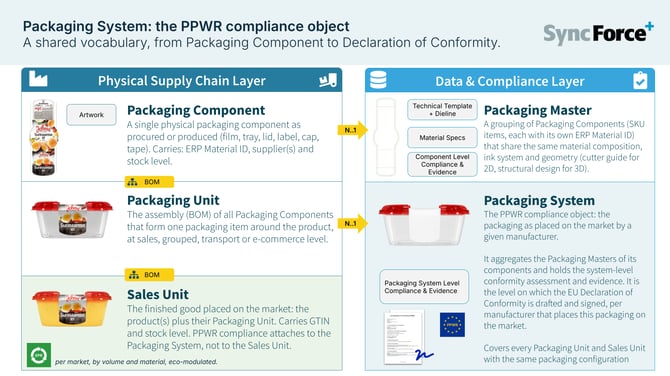
A Packaging Component is a single physical component (film, tray, lid, label, cap, tape), with its own ERP Material ID and supplier.
A Packaging Unit is the assembly, the bill of materials, of the Packaging Components that form one packaging around the product, at sales, grouped, transport or e-commerce level.
A Packaging System is the PPWR compliance object. It aggregates its components and holds the system-level conformity assessment and evidence. It is the level on which the DoC is drafted and signed, per manufacturer.
Applied to this question:
The Packaging Components that form one Packaging Unit roll up to one Packaging System, which carries a single DoC. Carton plus tape plus label is one Packaging System, so one DoC.
Each fixation element, the bundling tape, the straps, the stretch wrap, is its own Packaging Unit with a single component, rolling up to its own Packaging System, so its own DoC, with the manufacturer resolving to the supplier when it is unbranded.
Where a shipment carries several of these, the DoCs are bundled for the shipment under Article 39(3), but each remains its own assessment.
This keeps the compliance object stable: one DoC per Packaging System, whether that system has many components (the carton) or a single component (the wrap).
The rule to rememberPart of one packaging, so a component, shares one DoC, one Packaging System. Fixates several packagings, so its own packaging, its own DoC, its own Packaging System.
Regulatory basisDoC per unit of packaging, covering all integrated and separate components: PPWR Annex VII, and the Commission PPWR FAQ (August 2026), conformity assessment section. Pallets, pallet collars, wrappings and straps require separate assessments and separate DoCs: same FAQ section. Stretch wrap is packaging when sold on a roll, and multiple packaging items such as tape, wrap, boxes and pallets are each in their final form with possibly several manufacturers in one shipment: FAQ, manufacturer of transport packaging section. Recyclability, Article 6; minimisation, Article 10; empty space obligation on the party that fills, Article 24; bundling of DoCs, Article 39(3); packaging levels and the independence of a unit from grouped or transport packaging, Article 3(1) and the FAQ recyclability section.
This article is guidance for applying PPWR inside SyncForce, not legal advice.