
Packaging System is the level at which the EU Declaration of Conformity is drafted and signed. To get there, six concepts need to be aligned: the commercial units that are placed on the market (Sales Unit and Transport Unit) and the four packaging layers that sit on top of them. Two of those packaging layers are physical, two of them are data. Together they let you assess compliance once and reuse that assessment across every Sales Unit and Transport Unit that shares the same packaging composition.
Key principle. PPWR DoCs are per packaging level and are not nested. Every Sales Unit (Individual or Grouped) and every Transport Unit has its own Packaging System and its own DoC, and that DoC covers only the packaging introduced at that level. Packaging of a constituent Sales Unit inside a Grouped Sales Unit, or of a Sales Unit inside a Transport Unit, is covered by its own DoC. The model uses Sales, Grouped and Transport as functional types, not as a fixed three-layer hierarchy: real portfolios contain mixed pallets, counter displays, floor displays and other constructions that do not fit a one-two-three count. Any unit, at any level, that introduces new packaging gets its own Packaging System and its own DoC. The one exception is non-resellable items, which have no DoC of their own, so their packaging is included in the parent Sales Unit's DoC.
What is being packaged
Sales Unit. The unit placed on the market for sale to the end consumer. Product plus packaging. A Sales Unit appears in your portfolio as a sellable SKU and is the level at which volumes, prices and consumer-facing claims are managed. Two sub-types exist:
Individual Sales Unit. A single sellable product offered to the consumer as one piece. Example: one Mars bar. Its Packaging System and DoC cover only its own Sales packaging, for example the flow wrap around the bar.
Grouped Sales Unit. A multipack or in-store grouping that contains two or more Sales Units, placed on the market as one SKU. Examples: a Mars Family Pack of six bars, where each bar is also placed on the market as an Individual Sales Unit; a counter display in store that contains four Mentos 4-packs; a floor display containing several Grouped Sales Units. The Grouped Sales Unit introduces Grouped packaging, for example the pillow bag of the Family Pack or the tray and shrink wrap of the counter display. Its Packaging System and DoC cover only that Grouped packaging. The packaging of the Sales Units inside it is covered by their own DoCs and is not re-declared here. A Grouped Sales Unit can itself sit inside another Grouped Sales Unit (for example Mentos 4-packs inside a counter display): each level is its own compliance object.
A Sales Unit can also contain non-resellable items: items that form part of the assembly but are never sold separately to the consumer. Example: the individually wrapped Mars Minis inside a Party Pack. Because the Mini is not a Sales Unit in its own right and does not have its own DoC, the wrapper of each Mini is included in the parent Sales Unit's Packaging System and is covered by the parent Sales Unit's DoC.
Transport Unit. The unit used in the supply chain to move Sales Units to the point of sale. Examples: shelf-ready cases, trays, intermediate cartons, pallets, and mixed pallets. A Transport Unit contains one or more Sales Units, Individual or Grouped, and adds Transport packaging. Its Packaging System and DoC cover only the Transport packaging it introduces. The packaging of the Sales Units it carries is covered by the Sales Unit DoCs and is not re-declared at Transport Unit level. The model is not limited to a fixed number of layers: a mixed pallet can contain Grouped Sales Units that themselves contain Grouped Sales Units, and each level that introduces new packaging has its own Packaging System and its own DoC.
The four packaging layers
Packaging Component. The individual physical part that you procure and apply to a Sales Unit or Transport Unit. One ERP material, one supplier, one variant artwork. A Packaging Component is identified by its variant identity, not by where it is used: the same cap used on eleven Sales Units is one Packaging Component, not eleven. The most illustrative example is the label. For a salad range with eleven flavor variants, each flavor has its own top label and its own bottom label as a Packaging Component, because the printed sales unit artwork differs per flavor. Claim stickers such as MSC or Beter Leven are also Packaging Components in their own right.
Packaging Master. A SyncForce data object. Every Packaging Component, and every Packaging Assembly Unit, is linked to exactly one Packaging Master. The Packaging Master holds the technical base behind the Component: material composition, dimensions, ink system, and the Master Artwork with the cutterguide. The PPWR compliance assessment also lives here: substance restrictions including PFAS and heavy metals, recycled content per material, recyclability classification, and the supporting evidence and certificates. One Packaging Master can serve many Packaging Components, so the eleven flavor variants of a top label can all sit on a single Packaging Master, and the substance assessment is done once.
Packaging Unit. The total physical packaging applied to one Sales Unit or one Transport Unit at its own level. A Packaging Unit is a defined combination of one or more Packaging Components, brought together to contain, protect, handle, deliver or present the product at that level. It is the physical bill of packaging for what leaves the gate at that level, and it does not include the packaging of the Sales Units nested inside a Grouped Sales Unit or Transport Unit.
Packaging System. A SyncForce data object, and the PPWR compliance object . A Packaging System is the unique combination of Packaging Masters, with their quantities and units of measure, that together form the Packaging Unit of a Sales Unit or Transport Unit at its own level. SyncForce identifies each Packaging System by a fingerprint built from the ordered multiset of its Packaging Masters, so every Sales Unit or Transport Unit with the same composition resolves to the same Packaging System. The Declaration of Conformity is drafted, signed and revisioned at Packaging System level, and it covers only the packaging introduced at that level. System level PPWR checks apply here: minimisation, empty space ratio, recyclability classification, and reusability where relevant.
Example: Johma salad portfolio
Take this Johma salad portfolio as an example. Eleven flavor variants are placed on the market as Individual Sales Units in identical 175g cups. Five flavors share the base composition of Cup, Lid, Seal, Top label and Bottom label. Three flavors add an MSC sticker. Two flavors add a Beter Leven sticker. One flavor, the new ham-prei launch, temporarily carries a "Nieuw!" sticker.
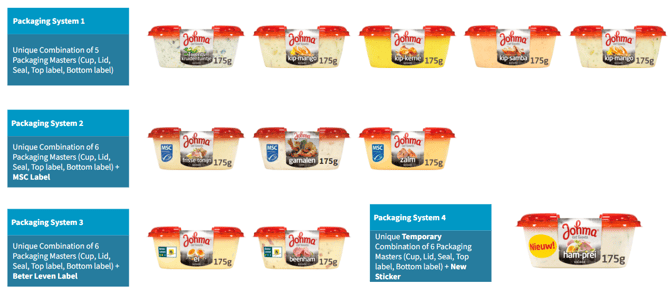
The result at Sales Unit level: eleven Sales Units, eleven Packaging Units, twenty-seven Packaging Components, and only four Packaging Systems. Four Declarations of Conformity, four signatures, instead of eleven. Any case, tray, pallet or in-store display used to ship or present these Sales Units carries its own DoC on top, covering only the packaging introduced at that level.